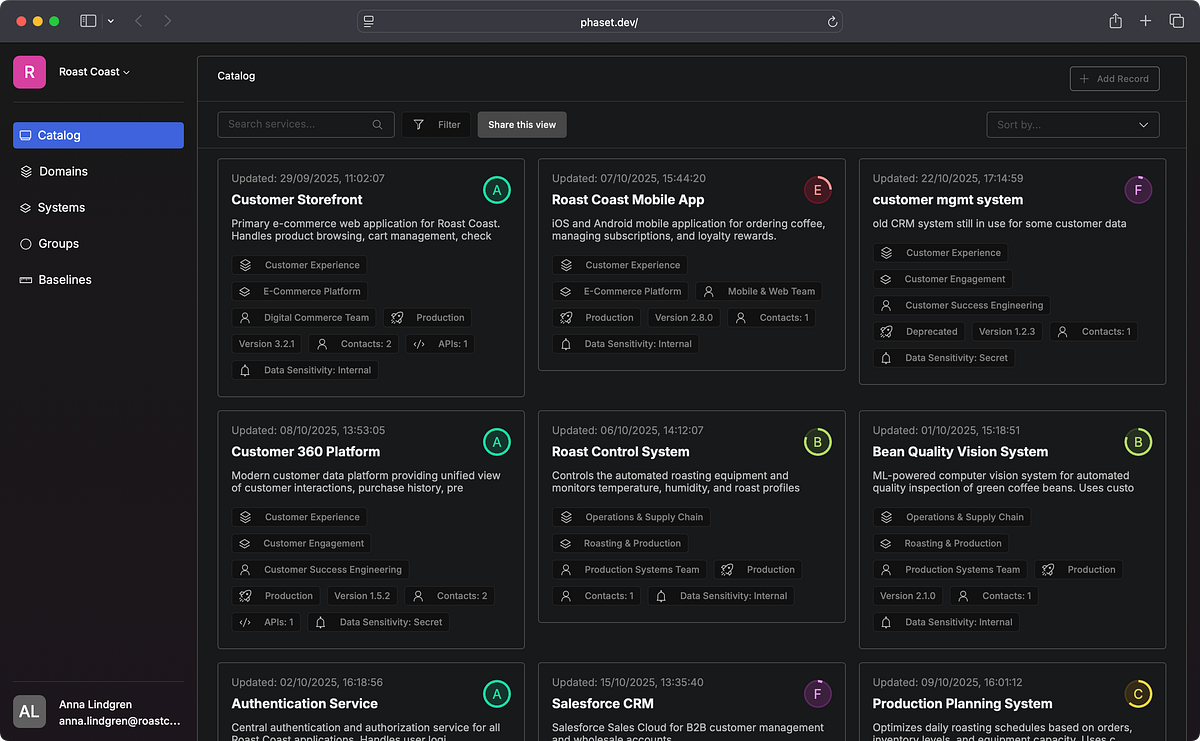
Phaset: The Better, Cheaper, Faster Option to Backstage, Cortex, Port, LeanIX and the Rest
Phaset is the self-hosted software knowledge platform that brings clarity to complex software landscapes — without the complexity or cost.
After 15 months of focused development — and nearly five years of evolution through various forms — I’m launching Phaset 1.0. What started as scattered pieces (technical health reviews, DORA metrics packages, an earlier productization attempt called LensDX) has crystallized into something I genuinely believe the industry needs.
If you’ve ever worked in an organization with more than 50 services, you know the pain points intimately: “Who owns this?” “What depends on what?” “Which systems are healthy, and which are silently degrading?” “Are we getting better at shipping software, or just busier?”
Phaset answers these questions. But more importantly, it does so in a way that respects three principles I’ve become increasingly committed to:
You own the solution. No vendor lock-in, no data leaving your infrastructure.
You control your data. 100%. No telemetry, no phone-home, no “anonymized” collection.
Your team will actually use it. Because it’s fast, simple, and delivers value in minutes — not months.
You Should Definitely Consider Phaset If…
- You have a non-trivial number of software assets (custom-built, purchased, M&A’d into your org, grand-fathered stuff…) and can’t keep track of who owns what
- You’re tired of stale wikis and Confluence pages that nobody updates
- You want to measure DORA metrics without building it yourself
- You need to enforce engineering standards across teams
- You’re evaluating M&A targets and need technical due diligence fast
- You’re onboarding engineers and it takes weeks to understand the landscape
- You care about data privacy and want self-hosted tools
- You’re exhausted by per-user pricing that punishes growth
Does that sound like anywhere you’ve worked?
So, what is Phaset?
Think of Phaset as the missing layer between your scattered wikis, half-assed processes, and your actual production systems. It’s what you get when you combine:
- The cataloging power of enterprise architecture tools (LeanIX, Ardoq) with their business-level visibility;
- The technical detail and automation of developer platforms (Backstage, Cortex) without their operational complexity;
- The measurement rigor of engineering analytics tools (DORA metrics, productivity insights) without becoming surveillance gimmickry.
The Core Capabilities
1) Software Catalog With Multi-Dimensional Views
It’s not just a list of services. Instead, Phaset lets you organize software across three independent dimensions simultaneously:
- Domain (business areas), such as “E-commerce”, “Payments”, or “Analytics”
- System (technical capabilities), such as “Checkout Flow” or “User Management”
- Group (team ownership), such as “Platform Team” or “Data Engineering”
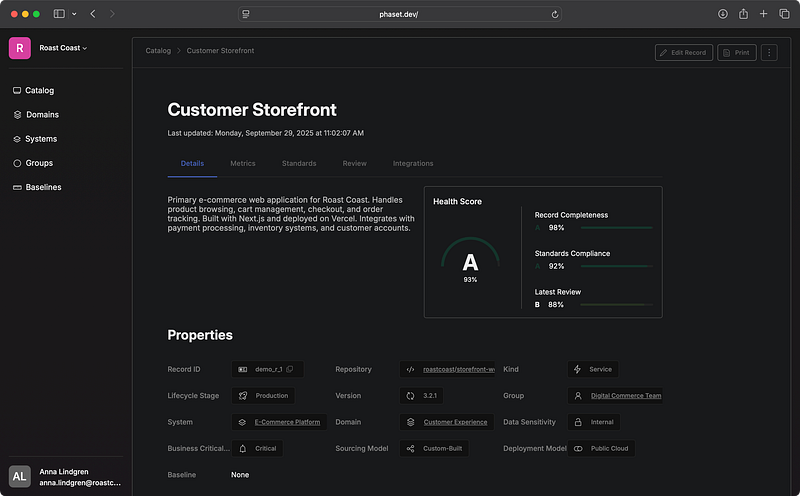
Different stakeholders think differently. Business leaders think in domains. Architects think in systems. Engineers think in teams. Phaset lets everyone ask questions their way while looking at the same software.
When your checkout system slows down at 2 AM, you don’t browse through 200 services, you filter E-commerce → Checkout → Payments Team and find the three services that matter in seconds.
2) Health Scores That Actually Mean Something
A single number that combines three dimensions of software quality:
- Standards Adherence: Automated checks for tests, docs, CI/CD configuration
- Record Completeness: Is ownership defined? Dependencies mapped? SLOs documented?
- Review Score: Human assessment of architecture, development, and operations
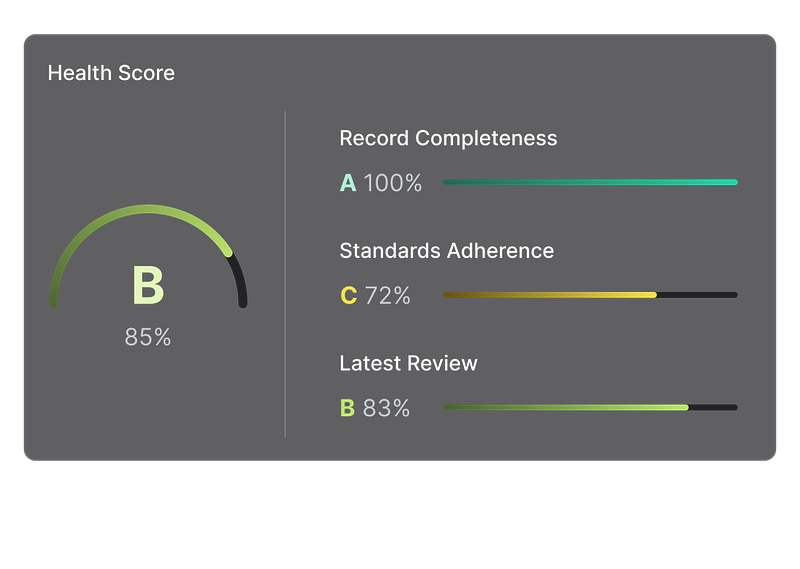
Most tools give you one or two of these. Phaset gives you all three, balanced into a letter grade (A-F) that tells you instantly: Is this healthy? Does it need attention? Should we be worried?
3) Structured Reviews (aka. “The Human Element”)
Here’s what most automation-first platforms miss: Not everything can be automated.
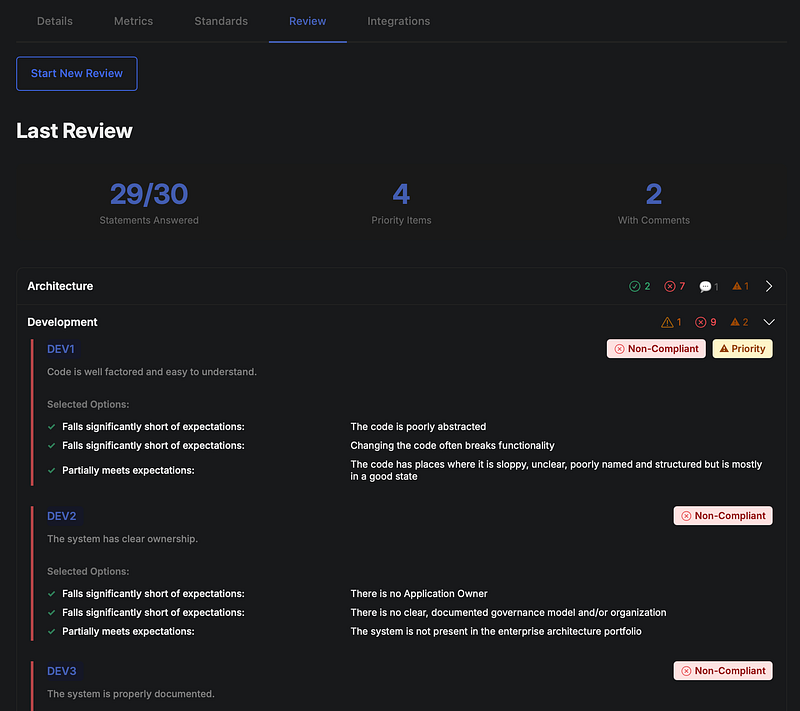
Phaset includes a structured review system — 30 questions across Architecture, Development, and Operations. These aren’t audits that people fear and loath. They’re conversation starters that create structured moments for teams to discuss what everyone knows but hasn’t said out loud:
- “Our architecture is getting brittle”
- “We don’t really understand our failure modes”
- “Nobody can onboard to this codebase”
Reviews turn whispers and silences into documented, prioritized action plans. They’re qualitative assessments that complement quantitative metrics.
4) Engineering Metrics Without the Surveillance Feel
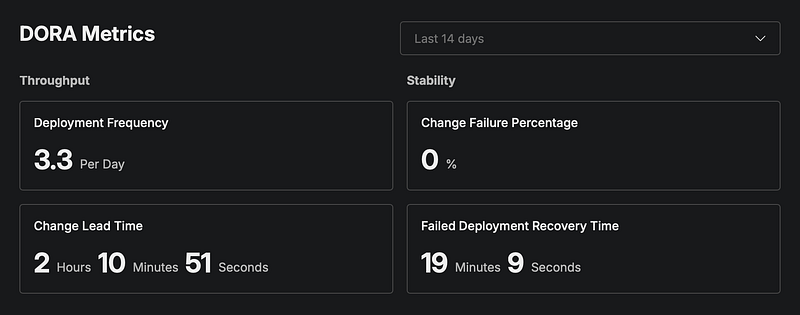
After appropriate configuration, you can track all four DORA metrics automatically:
- Deployment Frequency
- Change Lead Time
- Change Failure Rate
- Mean Time to Recovery
Plus broader engineering metrics: merge times, PR activity, code change patterns.
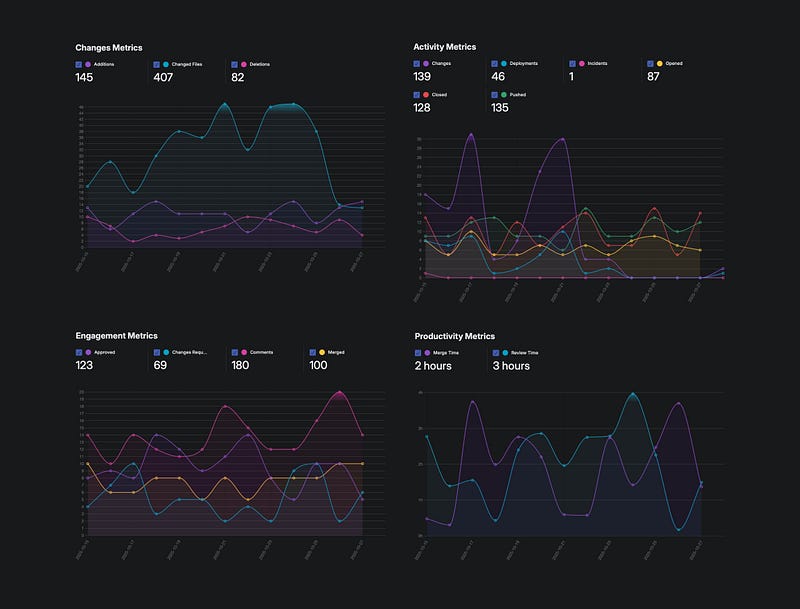
All data is anonymous, aggregated, and auto-deleted after 90 days. You get insights without crossing the line into individual tracking.
5) Standards and Compliance (Your Way)
Define what “good” looks like for your organization, not some consultant’s template that he inherited from his manager.
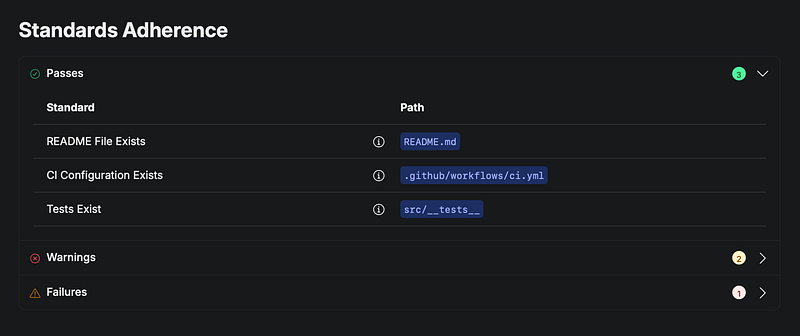
Create multiple Baselines for different needs:
- Production Services: Using strict rules for customer-facing systems
- Internal Tools: Having relaxed rules for utilities
- Experimental: Minimal rules for prototypes
- Legacy: More pragmatic rules for maintained and stable systems
Start lenient (warnings), tighten to errors as teams adopt standards. Phaset checks your standards automatically during CI/CD via StandardLint (open source).
What Makes Phaset Vastly Different
Installation in Minutes, Not Months
One command to get started: curl -sSL https://releases.phaset.dev/install.sh | bash
I know I rant about this but… No Kubernetes. No service mesh. No week-long configuration workshops. It runs on a Raspberry Pi if you want. Or a VPS…or Docker…or directly on a VM. Damn close to running on a toaster, actually!
It’s not uncommon that Backstage deployments take months to get working. I’ve never heard of enterprise architecture tools NOT requiring dedicated teams. Phaset installs in seconds and starts delivering value in minutes.
GitOps-Native Architecture
Your documentation lives in a phaset.manifest.json file in your repository. When you push
code, CI/CD updates your catalog automatically.
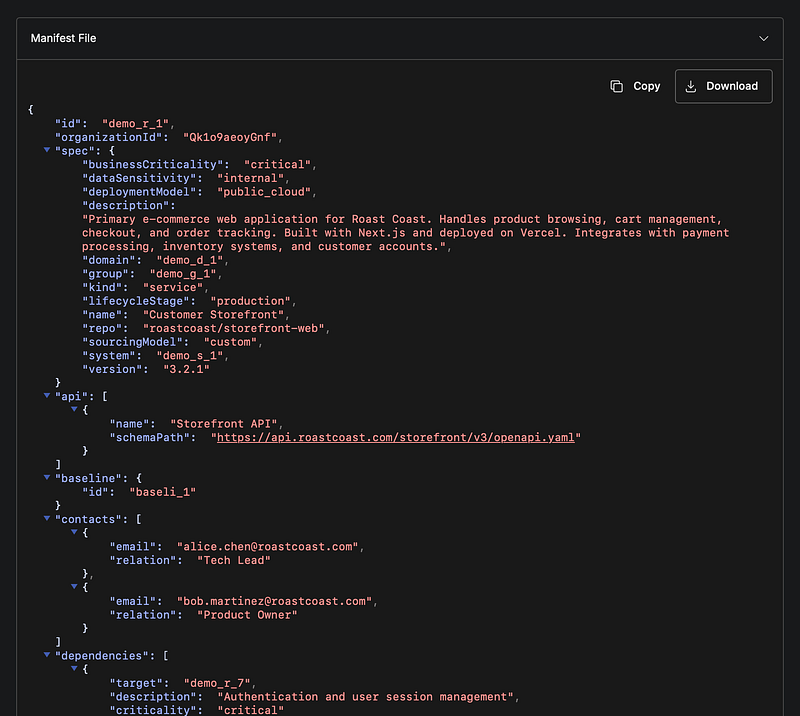
You have the same visibility, whether you check the manifest as part of the codebase or (as seen above) as inspected via the UI.
Documentation stays in sync because it’s part of your workflow, not a separate task you forget about.
And here’s the kicker: if you ever leave Phaset, your documentation is still valuable—it’s just JSON in your repos! Use it wherever you want or need.
Perpetual Licensing (Pay Once, Own Forever)
Most organizations have some degree of SaaS pain because of the continuous uptick in licenses, management, and total cost of ownership. Let’s reset the game and go classic. What if I told you…
- No subscriptions
- No per-seat pricing punishing your growth
- No “contact sales” bullshit
Instead:
- Personal use: Free forever
- Organizations up to 100 people: $249 once
- Unlimited users: $499 once
Support is included for a year and then extensible at a reasonable cost.
Essentially the deal is that you own the (major) version you buy. All updates within that major version (e.g. 1.x) are free forever. When 2.0 eventually ships, upgrade if you want — but your 1.x license just keeps working. Even if I discontinue development or decide to do something else. I will never be your problem.
Compare that to competitors: Let’s say a product like Cortex runs you $65/user/month × 100 developers = $78,000/year. Every year. Forever…

Complete Data Privacy
Self-hosted means your architectural data — your services, dependencies, team structures, metrics — never leaves your infrastructure. I never see it. Nobody sees it outside of your organization.
There’s no telemetry, analytics, or “phone home” checks beyond basic license verification at startup.
For security-conscious organizations (financial services, healthcare, government), this isn’t just a nice-to-have. It’s a requirement and I got you covered.
The Journey Here
This didn’t start 15 months ago. It started nearly five years ago with experiments, different approaches, pivots, ideas and sketches.
I built technical health review frameworks. I created DORA metrics calculators. As I mentioned, I tried productizing it into LensDX in 2023. That didn’t quite work. It didn’t feel right or tick the boxes we knew we could tick.
Last fall, with collaborators Axel Eriksson and Anton Ganhammar, we pivoted from Popcorn Cloud to what became Starlite, which ultimately became Phaset. The last 15 months have been focused, intense, and clarifying, and by this time in the story, the two other guys have had to throw in the towel due to natural reasons such as family. But here I am, and Phaset is out, also thanks to them. It’s like David Coverdale sang—
And here I go again on my own
Going down the only road I’ve ever known
Like a drifter I was born to walk alone
And I’ve made up my mind
I ain’t wasting no more time
There’s also an unexpected political subplot: We initially planned to sell Phaset as SaaS running on AWS. Then, well, certain political developments made me reconsider trusting U.S. cloud infrastructure with sensitive organizational data. And with the shift in the team, self-hosted became a goal.
So I pivoted hard to self-hosted. That decision — forced by external events — turned into one of Phaset’s biggest differentiators. Thank you, Donald Trump, for making me do the right thing. 😉
The bottom line is that no matter where you are based, you end up getting a better deal than if I’d have gone the same old route all other SaaS players walk.
Try It Today—It’ll Take You Just Minutes
The free personal license includes the full feature set. Organizations can evaluate for 30 days at no cost.
Install the API (Linux/macOS):
curl -sSL https://releases.phaset.dev/install.sh | bash
…or Pull the Container:
docker pull ghcr.io/phasetdev/phaset-api:latest
Download the Web App:
Static site bundle ready to serve from any web host
Setup takes just a few minutes. You’ll have your first service cataloged in under a coffee break.
See the full documentation at docs.phaset.dev.
What’s Next
Phaset 1.0 is the foundation. I’ve got a bunch of ideas I’d like to add after enjoying at least one weekend without coding 🍹🏝️
More importantly, I’d love to hear about your needs and any problems that Phaset could help solve!
Phaset 1.0 is complete, stable, and ready for use today. It’s the tool I wished existed five years ago. But then again, someone would have either required running it on Kubernetes or asked for crazy money (which is what they all do, right?) 😉
If you’ve read this far, you probably feel the same pain points I did. Maybe Phaset can help.
Try Phaset: phaset.dev
Read the docs: docs.phaset.dev
Join the Discord: discord.gg/6Y77kQB5k2
And if you buy a license, thank you. You’re supporting indie software that respects your privacy, your data, and your intelligence.
Let me know what you think!
— Mikael Vesavuori
November 1st, 2025
Göteborg, Sweden 🇸🇪
P.S. — If you’re a journalist, analyst, or content creator interested in covering Phaset, I’m happy to provide demo access, technical deep dives, or interviews. Reach me at [email protected]